

Why Learning How to Perform CPR is Essential for Every Indian
Imagine you are walking through a crowded market in Delhi, or perhaps you are at a family gathering in Mumbai, when suddenly someone collapses. Their breathing is irregular, and they are unresponsive. In India, where traffic congestion often delays ambulance services and the rate of sudden cardiac arrest is rising, the first few minutes after a collapse are critical. This is where Cardiopulmonary Resuscitation, or CPR, comes into play. Knowing how to perform CPR is not just a medical skill; it is a life-saving tool that empowers you to act when every second counts.
Cardiac arrest can happen to anyone, regardless of age or fitness level. In many Indian households, elderly family members are at higher risk, but we are also seeing an increase in heart-related emergencies among younger adults. By the time professional medical help arrives, the brain may already have suffered irreversible damage due to a lack of oxygen. If you know how to perform CPR, you can keep blood flowing to the brain and vital organs, significantly increasing the victim's chances of survival. This guide will walk you through the process in a simple, step-by-step manner tailored for the Indian context.
The Initial Assessment: Safety and Response
Before you rush in to help, you must ensure that the environment is safe for both you and the victim. In India, this might mean checking for heavy traffic if the incident happened on a road, or ensuring there are no loose electrical wires if the collapse happened at home or work. Your safety is the priority; you cannot help someone if you become a victim yourself.
Step 1: Check for Responsiveness
Gently tap the person on their shoulders and shout loudly. You can use common terms like 'Bhaiya,' 'Didi,' or 'Uncle' to get their attention. Ask, 'Are you okay?' or 'Kya aap theek hain?' If there is no movement, moaning, or blinking, the person is unresponsive.
Step 2: Check for Breathing
Look at the person's chest to see if it is rising and falling. Do this for no more than 10 seconds. If the person is not breathing or is only gasping intermittently (agonal breathing), you must assume they are in cardiac arrest. Do not spend too much time looking for a pulse if you are not a trained medical professional, as this can waste precious seconds.
Step 3: Call for Help (The Indian Emergency Numbers)
In India, the primary emergency number for an ambulance is 108 in most states, or 102 for specific medical services. If you are in a crowded area, point to a specific person and say, 'You, call 108 and tell them we have an unconscious person.' Giving a specific command is more effective than shouting 'someone call for help,' as people often hesitate in a crowd due to the bystander effect.
How to Perform CPR: The C-A-B Method
The American Heart Association and the Indian Resuscitation Council suggest the C-A-B sequence: Compressions, Airway, and Breathing. For untrained bystanders, 'Hands-Only CPR' (just compressions) is often recommended and is highly effective.
Step 4: Chest Compressions (Push Hard and Fast)
This is the most crucial part of how to perform CPR. Compressions act as an external heart, manually pumping blood through the body.
- Positioning: Place the person on their back on a firm, flat surface (the floor is better than a bed). Kneel beside their chest.
- Hand Placement: Place the heel of one hand in the center of the person's chest (on the lower half of the breastbone). Place your other hand on top of the first and interlock your fingers.
- Body Posture: Keep your elbows locked and your shoulders directly over your hands. Use your body weight, not just your arm strength, to push down.
- Depth: Push down at least 2 inches (5 centimeters) but no more than 2.4 inches. You need to push deep enough to compress the heart between the breastbone and the spine.
- Rate: Aim for a rate of 100 to 120 compressions per minute. A good way to keep this rhythm is to push to the beat of the famous song 'Stayin' Alive' or the Bollywood track 'Kar Har Maidaan Fateh.'
- Recoil: Allow the chest to return to its original position after every push. Do not lean on the chest between compressions; the heart needs to refill with blood.
Step 5: Opening the Airway
If you are trained in CPR and comfortable giving rescue breaths, use the 'head-tilt, chin-lift' maneuver. Gently tilt the head back with one hand and lift the chin with the other to open the air passage. In cases of suspected neck injury, this should be done very carefully or avoided by those who are not trained.
Step 6: Rescue Breaths
Pinch the person’s nose shut and create a complete seal over their mouth with yours. Give two rescue breaths, each lasting about one second. Look to see if the chest rises. If the chest does not rise, reposition the head and try again. After two breaths, immediately return to chest compressions. The ratio is 30 compressions followed by 2 breaths.
The Good Samaritan Law in India
One of the biggest reasons people in India hesitate to perform CPR is the fear of legal trouble or police harassment. It is important to know that the Supreme Court of India approved the 'Good Samaritan Law' in 2016. This law protects bystanders who help victims of accidents or medical emergencies from any civil or criminal liability. You cannot be forced to disclose your identity, stay at the hospital, or pay for the victim’s treatment. This law was specifically created to encourage people like you to step forward and save lives without fear.
CPR for Infants and Children
The technique for how to perform CPR changes slightly for younger victims. Their bodies are more fragile, and the causes of cardiac arrest are often respiratory rather than cardiac.
CPR for Children (1 year to Puberty)
Use the same 30:2 ratio as adults. However, depending on the size of the child, you might only use one hand for compressions instead of two. The depth should be about 2 inches.
CPR for Infants (Less than 1 year old)
- Check for response by flicking the bottom of the infant's foot.
- Use two fingers in the center of the chest, just below the nipple line.
- Compress the chest about 1.5 inches (4 centimeters).
- The rate remains 100-120 compressions per minute.
- Give very gentle puffs of air instead of full breaths.
Using an AED (Automated External Defibrillator)
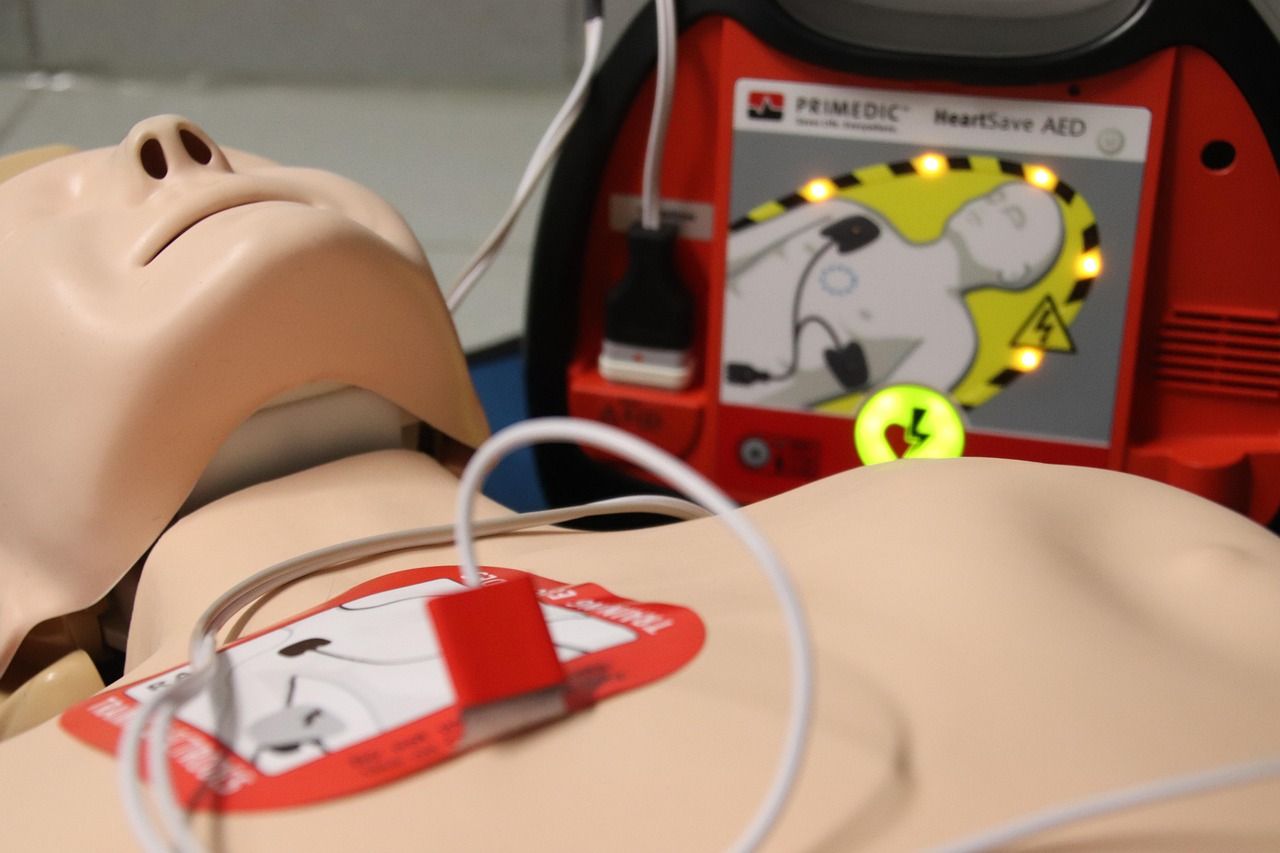
An AED is a portable device that can analyze the heart's rhythm and deliver an electric shock if necessary to restart the heart. While not yet common on every street corner in India, they are increasingly found in major airports (like IGI in Delhi or Chhatrapati Shivaji in Mumbai), large corporate offices, and modern shopping malls. If an AED is available, turn it on immediately and follow the voice prompts. The device will tell you exactly what to do, including when to stop CPR and when to deliver a shock.
Common Mistakes to Avoid
When learning how to perform CPR, it is just as important to know what not to do. Avoiding these common errors can make your efforts more effective.
- Bending the elbows: This leads to quick exhaustion and shallow compressions. Keep arms straight.
- Interrupting compressions: Try not to stop compressions for more than 10 seconds. Constant pressure is required to keep the blood moving.
- Worrying about broken ribs: It is common to hear a cracking sound during CPR. These are often the ribs or cartilage breaking. While it sounds scary, a broken rib can heal; a dead brain cannot. Do not stop because you heard a crack.
- Giving up too soon: Continue CPR until professional medical help arrives, an AED is ready to use, the person starts to wake up, or you are physically unable to continue.
Conclusion: Be the Hero Your Community Needs
The thought of performing CPR can be intimidating, but remember that doing something is always better than doing nothing. In a cardiac arrest situation, the person is technically already in a life-threatening state; your intervention is their only hope. By understanding the steps of how to perform CPR and familiarizing yourself with India's emergency protocols and the Good Samaritan Law, you become a vital link in the chain of survival.
While this guide provides the essential steps, we highly recommend attending a certified first-aid and CPR workshop. Many organizations like the Red Cross India, St. John Ambulance, and various private hospitals offer short courses. Encourage your family, friends, and colleagues to learn as well. In a country as vast as ours, the power to save a life often rests in the hands of the person standing right next to the victim. That person could be you.
Can I get in trouble if I perform CPR incorrectly in India?
No. Under the Good Samaritan Law in India, bystanders who provide emergency assistance are protected from legal and criminal liability. The law is designed to ensure that you can help someone in need without fearing police questioning or court appearances.
What is the emergency number to call for an ambulance in India?
You should call 108 for emergency medical services in most Indian states. In some regions, 102 is also used for ambulances. If you are unsure, 112 is the pan-India emergency response number that can redirect you to the appropriate service.
Should I still do mouth-to-mouth if I don't have a barrier mask?
If you are not trained or are uncomfortable with mouth-to-mouth resuscitation, you should perform 'Hands-Only CPR.' This involves continuous chest compressions at a rate of 100-120 per minute. Research shows that Hands-Only CPR is highly effective for the first few minutes of an adult cardiac arrest.
How do I know if I am pushing hard enough during CPR?
For an adult, you need to compress the chest by at least 2 inches. It requires a significant amount of force. Do not worry about hurting the person or breaking a rib; the goal is to keep their blood circulating to their brain and heart.


